>> Phantoms

The European micro-nanotechnology
business accelerator for small
and medium-sized enterprises
>> Phantoms |
The European micro-nanotechnology business accelerator for small and medium-sized enterprises |
Phantoms
In order to avoid European industry and R&D being left behind the United States and Japan in this fast emerging nanoelectronics field, the PHANTOMS Network scheme will promote European science and research through a pluri-national networking action, put together research capacities present in the various European regions and stimulate commercial nanoelectronic applications. The Network (funded by the European Commission through the FP5 IST programme) is of a truly interdisciplinary character (members come from government, universities and industry at the top of their fields in Europe) and involves currently 176 partners from 22 different European countries, 8 from the US, 1 from Canada, 1 from Japan and 1 from India (see Figure 2).
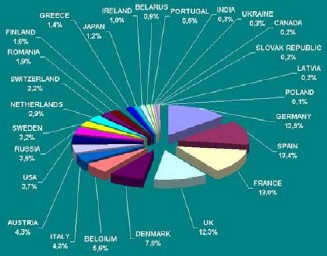
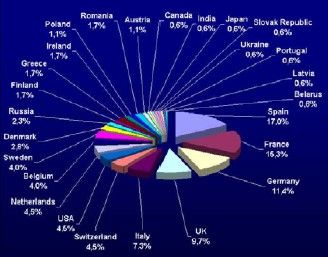
Figure 1: Percentage of people working at Phantoms groups per country (total number of people is 1458).
Figure 2: Percentage of group members per country involved in Phantoms (total number of groups is 176).
Thus linking research strategies in a consortium of participants coming from different fields and promoting exchange of researchers fosters the understanding between the groups coming from different directions. This is a crucial point that helps ensuring the competitiveness of Europe in this fast emerging field. Defining the right objectives that need to be addressed in the research and development projects can be a key to developing European competitiveness in future generations of electronics.
Research areas and key aspects
The research areas addressed by the PHANTOMS Network are the following:
• Lithography
• Nanoimprint/Micro contact Printing
• Architecture
• Nanoprobes
• Silicon/Industry
• Superconductors
• Magnetoelectronics
• Molecular and Bioelectronics (Fullerenes, biomolecules, etc.)
• Nanoscale Optics
• Self-assembly/combination of Silicon technology and molecular based electronics
An important objective is mainge industry aware of the strategic importance of nanoelectronic research for the future of information technology (IT) in general and of microelectronics in particular. For this purpose, the network promotes intensively industrial participation in the Network activities (13% of the members belong to industry), informing the industry about relevant progress in nanoelectronics and providing a feedback loop for industrial mid and long-term interests.
The key aspect of an emerging technology network is interaction, and this is achieved in the following ways:
- Exchange of information during workshops organised within the network.
- Scientific exchange between partners by short research visits of scientists and students (PHANTOMS grants)
- A web based source of information (http://www.phantomsnet.com) related to nanoelectronics based for example on:
- A list of all active research groups and companies presently involved in Nanoelectronics (Key personnel, skills, infrastructure, etc.).
- Dissemination of basic research results (publications, abstracts, references per group and/or topic, conference proceedings, etc.), EU reports, EU projects' results (NID, FET Open, etc.), patents, etc.
- Dissemination of information and news related to nanoelectronics such as conferences, workshops, job opportunities (from companies and Universities), grants (EU, University groups, etc.), etc.
By the provision of the above, a thriving multidisciplinary network of European universities, companies and laboratories is working together to establish access to world-class nanoelectronic applications for all European citizens. The network represents a "single entry point" for those seeking information in Nanotechnology and especially Nanoelectronics.
Membership and funding
The membership is restricted to research groups (belonging to legal entities such as universities, research institutes, industry, etc.) active in the field of "Nanotechnology for Information Processing and Storage. Membership is open worldwide (including for example USA or Japan). Note that the general EC rules for funding apply and that priority will be given to funding requests submitted by PHANTOMS members.
Funding opportunities within the network are:
- Grants to cover partially expenses in order to assist to events and PHANTOMS Workshops organised within the network.
- Financial support to conference organisation.
- Financial support to short scientific exchanges (priority will be given to exchanges involving industry). Network funding will follow European Commission rules.
PHANTOMS members should be active and provide their support to the network activities: participate to PHANTOMS workshops, provide periodically material for the PHANTOMS website or related initiatives such as the PHANTOMS Newsletter, etc...
The Network aims to become a reference point on Nanotechnology and especially Nanoelectronics.
All information on PHANTOMS can be found at http://www.phantomsnet.com.